
 Game Development
  Game Art
 Resource Augmentation
 VR/XR Simulation
Outsourcing Game Art Production for Australian Game Studios

-
 Art & Design
 Apr 6th, 2026
- Share:
Table of Contents
- Why Australian Game Studios Are Turning to Game Art Outsourcing
- TL;DR- A Quick Summary
- The Growth of Game Development in Australia
- Understanding Game Art Outsourcing
- When Should an Australian Studio Outsource Game Art?
- Types of Game Art Commonly Outsourced
- Build In-House vs. Outsource vs. Co-Develop: Which Model Is Right?
- Benefits of Outsourcing Game Art Production
- Outsourcing Costs and Engagement Models for Australian Studios
- How Do Australian Studios Ramp Up Art Production Quickly?
- What Is the Fastest Way to Scale Game Art Production in Australia?
- Why Is Art Production Scalability Critical for Australian Studios?
- Factors to Consider When Outsourcing Game Art
- Challenges in Game Art Outsourcing
- Where Juego Studios Fits In
- The Future of Game Art Production and Outsourcing
- Conclusion
Australian studios are shipping globally competitive titles with lean internal teams — not because they have unlimited budgets, but because they know when to build in-house and when to scale through the right external partners.
For most studios, the breaking point arrives in one of three ways: a missed milestone that costs publisher trust, a hiring delay that stretches a six-month backlog into twelve, or a cost blowout that forces scope cuts mid-production. All three are symptoms of the same structural problem — art production capacity that cannot keep pace with delivery commitments.
For art production specifically, the question is no longer whether to outsource. It is how to do it without losing control of visual consistency, IP, or delivery timelines.
Why Australian Game Studios Are Turning to Game Art Outsourcing
Australia’s game development sector has evolved significantly over the past decade. According to the Interactive Games and Entertainment Association (IGEA) Australian Game Developer Survey (AGDS), the industry generated AUD $339.1 million in developer revenue in FY2024 — broadly consistent with AUD $345.5 million in FY2023 — reflecting a sector that has more than doubled in commercial scale over five years. The FY2023 survey recorded 2,458 full-time equivalent developers across approximately 400–500 active studios, the majority of which operate with lean teams of fewer than 10 full-time staff.
From small indie collectives to well-funded mid-sized studios, Australian developers are now delivering titles that compete on a global stage. Australian video games like Hollow Knight (Team Cherry) and Unpacking (Witch Beam) have achieved international recognition — including BAFTA nominations and combined sales exceeding 4 million units — demonstrating that the creative talent exists locally. The challenge, as the industry scales, is production capacity.
Art production — characters, environments, animations, UI — represents one of the most resource-intensive phases of game development. The average mid-tier game requires between 500 and 3,000 individual art assets, and for studios with teams of 10 to 50, producing this volume in-house is often structurally impossible within commercial timelines. A senior game artist in Australia commands an average salary of AUD $90,000–$120,000 per year, compared to $30,000–$55,000 in equivalent markets in South and Southeast Asia — a cost differential that makes outsourcing a financially rational decision even before quality and capacity factors are considered.
Maintaining a full-stack in-house art department is expensive and difficult to justify when project scope fluctuates. This is why outsourcing game art production for Australian game studios has become a core strategic decision, not an afterthought. The introduction of the 30% Digital Games Tax Offset (DGTO) has further strengthened the case: when combined with additional state-level incentives, studios can reduce effective development costs by up to 45%, making Australian game development companies increasingly viable candidates for international co-development arrangements and scalable outsourcing partnerships.
This article provides a practical industry breakdown of game art outsourcing in Australia: what it covers, why studios are adopting it, how to choose the right engagement model, and what to watch for as the practice evolves into 2026 and beyond.
TL;DR- A Quick Summary
- Australian game studios outsource art production to manage cost, scale teams, and access specialized global talent.
- Common outsourced art types include concept art, 2D/3D assets, animation, and UI/UX design.
- Engagement models range from project-based fixed scope to dedicated art pods and staff augmentation.
- The 30% Digital Games Tax Offset (DGTO) significantly affects how cost-effective each model is for local developers.
- Style consistency, IP protection, and pipeline alignment are the three biggest risks to manage.
- AI-assisted tools and engine-ready delivery are reshaping outsourcing expectations in 2026.
- Juego Studios has delivered 200+ projects across mobile, PC, console, and XR — serving as a scalable game art and co-development partner for studios and publishers worldwide.
The Growth of Game Development in Australia
Australia’s game development industry has entered a period of sustained growth. The country now hosts over 700 active studios and more than 1,400 individual developers, with revenue exceeding AUD $284 million — figures that represent a sector that has more than doubled in commercial scale over the past five years.
The video game industry in Australia faces structural challenges, however. Production costs are high relative to competing markets, the local talent pool — while skilled — is limited in scale, and many studios lack the internal capacity to handle both development and high-volume art production simultaneously. Screen Australia data indicates that the majority of game businesses in the country operate with fewer than 10 full-time employees, making external art partnerships a practical operational necessity for any studio pursuing a title with meaningful production scope.
These dynamics have made game art outsourcing in Australia not an exception but an industry norm. Studios that manage their outsourcing relationships well compress production timelines, maintain quality targets, and protect internal teams from unsustainable crunch — particularly critical given Australia’s tight developer talent market and the reputational cost of staff burnout.
Understanding Game Art Outsourcing
Game art outsourcing refers to the practice of engaging external studios or specialist teams to produce visual assets that are integrated into a game’s production pipeline. Rather than building every asset internally, development studios delegate specific creative tasks to partners with relevant expertise, scale, or cost efficiency.
In modern game production, outsourcing is not a signal of reduced ambition. It is a production methodology. Major AAA publishers, mid-sized studios, and funded indie developers all use external art partners to manage asset volume, specialization requirements, and production timelines simultaneously.
For Australian studios specifically, game art outsourcing in Australia typically involves engaging partners across Asia, Eastern Europe, or South Asia — regions with established game art talent pipelines — while retaining art direction, design leadership, and final QA internally. The goal is to maintain creative ownership while expanding output capacity beyond what a local in-house team can sustain.
When Should an Australian Studio Outsource Game Art?
Not every production phase calls for external art partners. Knowing when the trigger conditions are met — and acting before the problem compounds — is what separates studios that outsource strategically from those that outsource reactively.
| Trigger Signal | What It Indicates | Consequence If Ignored |
| The internal art team is producing less than 60% of the required weekly asset volume | Structural capacity gap, not a temporary bottleneck | Milestone slippage, publisher trust erosion |
| Art backlog is growing sprint-over-sprint despite full team utilization | Scope has outpaced staffing — the gap will widen | Crunch, burnout, and attrition of key staff |
| Specific art discipline (e.g., VFX, technical art) unavailable in-house | Skill gap requiring specialist expertise | Substandard assets or costly, delayed hiring |
| Per-asset production cost exceeds the outsourcing market rate by 2x or more | In-house production is financially inefficient at the current volume | Budget overruns that compress later production phases |
| Art direction rework is consuming more than 20% of producer’s time | Inconsistent output is generating internal QA overhead | Rework costs exceed the original production cost |
| Platform certification or launch window is fixed and non-negotiable | Timeline cannot absorb sequential production — parallelization required | Missed certification windows, delayed revenue |
If your studio is experiencing two or more of the signals above, you are no longer dealing with a temporary production bottleneck — you are facing a structural capacity gap. At this stage, continuing with an in-house-only approach will almost always result in missed milestones, increased rework, or unsustainable team strain.
This is the point where outsourcing game art production becomes a production requirement — not an optional optimization.
For most Australian studios in this position, the fastest and lowest-risk next step is to engage either a fixed-scope outsourcing partner for immediate backlog relief or a dedicated art pod for sustained production support. If the backlog is limited to a specific asset type, start with a fixed scope; if it spans multiple sprints, a dedicated pod is more efficient.
The rule of thumb: if two or more of these signals are present simultaneously, the case for outsourcing is structural, not circumstantial.
Types of Game Art Commonly Outsourced
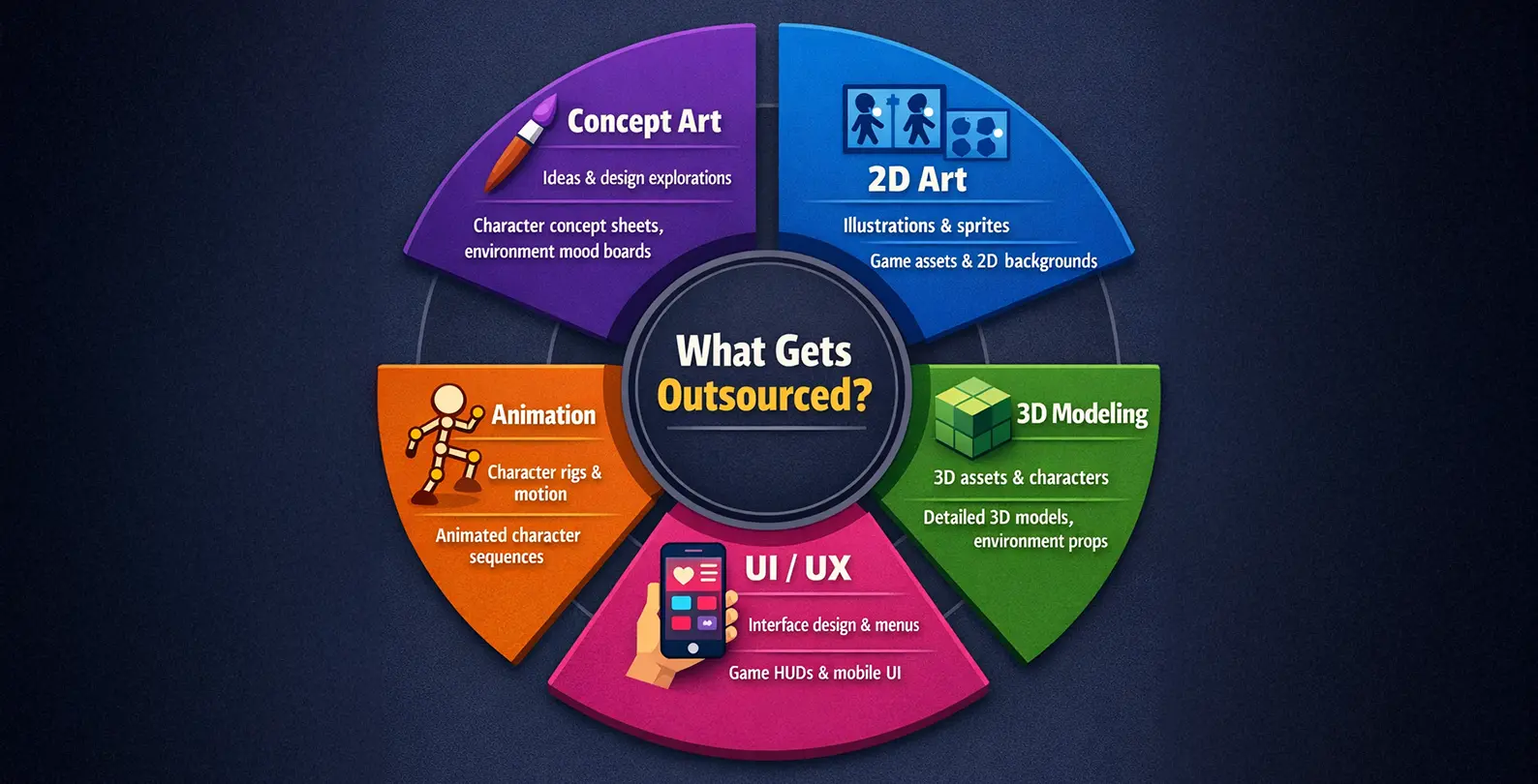
Game art outsourcing for Australian studios spans a wide range of disciplines. Understanding what is typically delegated externally helps production managers structure their outsourcing strategy effectively.
Concept Art
Concept art is often the first production phase where studios engage external partners. Outsourcing concept art allows studios to rapidly visualize characters, environments, and game worlds without locking senior internal artists into early-stage exploration work. External concept teams can produce high volumes of reference imagery quickly, helping directors identify visual direction before committing to full production.
2D Art and Illustration
2D art outsourcing covers a broad asset category: UI backgrounds, promotional artwork, sprite sheets, icon libraries, and in-game illustrations. For mobile-first studios, this is often the highest-volume outsourcing category. External teams familiar with the platform’s style conventions and technical constraints — file size limits, resolution scaling, platform store requirements — can handle batch production efficiently while the internal team focuses on design leadership.
3D Modeling and Asset Creation
3D asset outsourcing is where scale requirements typically justify external production most clearly. Characters, props, environmental sets, weapons, and vehicles are all routinely outsourced. For external production to integrate cleanly, partner teams need demonstrated compatibility with the target game engine — Unity or Unreal Engine are the industry standards — including correct polycount targets, LOD generation, UV mapping conventions, and PBR texturing workflows.
Animation
Animation outsourcing includes character locomotion sets, combat animations, idle states, facial expressions, motion capture data cleanup, and cinematic sequences. Studios working on projects that require high animation volume — action games, RPGs, sports titles — frequently delegate secondary animation passes and supporting character rigs to external teams while keeping hero character animation in-house.
UI and Visual Design
UI/UX outsourcing covers HUD design, menu flows, onboarding screens, icon sets, and in-game interface systems. Strong UI outsourcing requires external teams to understand platform interaction conventions — touch vs. controller vs. mouse — and to design for localization flexibility and accessibility compliance from the outset. Studios that get this right gain polished, player-tested interfaces without diverting internal engineering resources.
Where to Start: Prioritizing by Production Bottleneck
Not all art categories need to be outsourced at once. The most effective approach is to prioritize based on where your current production is constrained:
- If your team is struggling with early-stage visual direction → outsource concept art to accelerate exploration and lock style before committing full production resources.
- If high-volume asset production is slowing down sprints → outsource 2D or 3D asset creation, where external capacity has the most direct impact on throughput.
- If gameplay feels or polish is lagging → outsource animation to improve player experience without pulling engineering off core systems work.
- If usability or retention metrics are weak → outsource UI/UX design for focused interface optimization, often the fastest lever on D1 and D7 retention.
For most Australian studios, outsourcing begins with the highest-volume or most time-intensive asset category — where internal capacity constraints have the greatest impact on delivery timelines. Starting there produces immediate relief and gives the team a low-risk proof of concept before expanding the outsourcing relationship.
Build In-House vs. Outsource vs. Co-Develop: Which Model Is Right?
Australian studios at different stages of growth need different production structures. This comparison helps production managers and studio heads make the right call before committing budget.
| Factor | Build In-House | Outsource (Fixed Scope) | Outsource (Dedicated Pod) | Full Co-Development |
| Best For | Long-term IP with ongoing sequels | One-off asset batches with clear specs | Ongoing production over 6+ months | Full title builds where the internal team lacks capacity |
| Upfront Cost | High (hiring, tools, onboarding) | Low (fixed deliverable cost) | Medium (monthly retainer) | High (full team alignment) |
| Monthly Cost | AUD $90K–$200K+ (team of 5–10) | Per-delivery — no ongoing commitment | USD $15K–$35K per pod | Structured by scope and milestone |
| Control Level | Full | Low — vendor manages process | Medium — art direction retained | Highly embedded collaboration |
| Ramp Speed | 6–12 weeks (hiring + onboarding) | 1–2 weeks | 1–2 weeks | 2–4 weeks |
| Scalability | Low headcount is fixed | Low — new contract per batch | High — pod size adjustable | Medium — scope changes require negotiation |
| IP Risk | None | Low (with NDA + escrow) | Low (with NDA + escrow) | Low (with NDA + escrow) |
| DGTO Compatibility | Eligible if qualifying spend | Partially eligible | Eligible as qualifying service expenditure | Eligible |
How to choose:
- If your studio has a stable, long-term IP roadmap and can sustain full-time art staff year-round → Build In-House
- If you have a defined, bounded art task with clear specs and a fixed budget → Fixed Scope Outsourcing
- If you need sustained art output over multiple sprints without managing headcount → Dedicated Art Pod
- If you lack internal capacity for an entire production layer (e.g., you have no 3D team) → Full Co-Development
The majority of mid-sized Australian studios operating on 12–24 month project cycles land in the Dedicated Pod or Co-Development category once they account for the total cost of ownership.
Benefits of Outsourcing Game Art Production
Access to Global Specialist Talent
The global pool of game art professionals is substantially larger than what any single market can sustain. Outsourcing game art services gives Australian studios access to artists with niche expertise — technical art optimization, stylized rendering, photorealistic character work, Spine 2D animation — that may not be readily available or cost-effective to hire locally.
Cost Efficiency Without Quality Compromise
Maintaining a large in-house art team carries fixed overheads — salaries, tools, office infrastructure, benefits — that remain constant regardless of project phase. Outsourcing converts fixed art production costs into variable, project-aligned expenditure. For Australian studios already utilizing the DGTO, structuring outsourcing costs correctly can further improve effective cost ratios.
Faster Production Pipelines
External art teams can handle parallel production tracks that would bottleneck an internal team forced to work sequentially. A studio can have environment artists working on level sets while character teams produce hero assets simultaneously — all externally managed — compressing the overall production schedule significantly.
Scalability Aligned to Project Phases
Game production is inherently non-linear. Asset requirements peak during mid-production and taper during polish and certification phases. Outsourcing allows studios to scale art teams up for high-volume production phases and scale down without redundancy costs afterward — a flexibility that permanent hires cannot replicate.
Outsourcing Costs and Engagement Models for Australian Studios
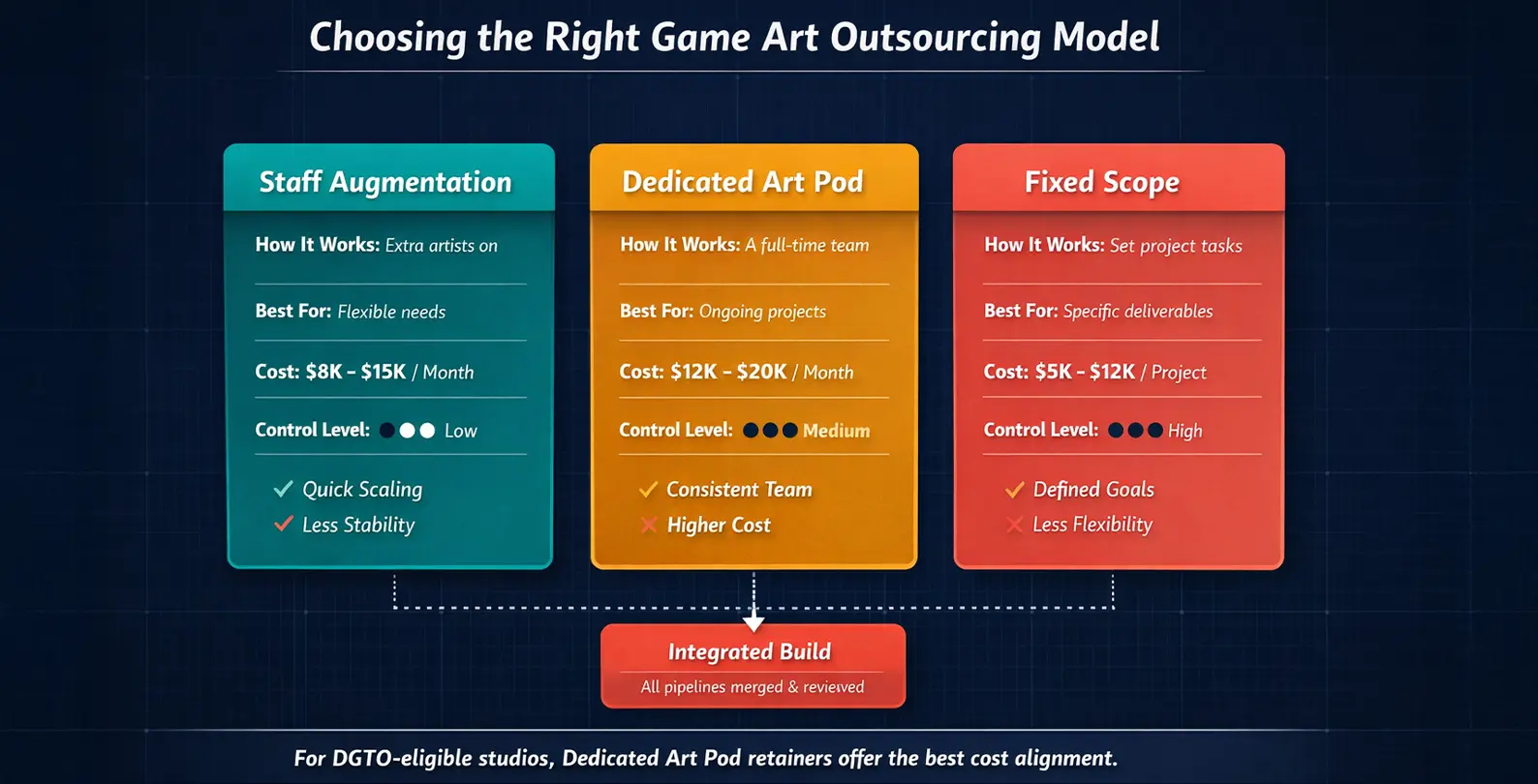
For studios evaluating game art outsourcing in Australia, understanding the cost landscape across engagement models and asset types is essential for accurate project planning. The table below reflects 2026 market rates in USD, the standard for international outsourcing contracts.
| Art Type / Engagement | Scope / Unit | Budget Range (USD) | Notes |
| Character Art — High-Fidelity (AAA) | Per character | $3,000 – $15,000+ | PBR textures, LODs, and rigging included |
| Character Art — Stylized / Mobile | Per character | $800 – $3,500 | Spine-ready or Unity-optimized |
| Environment Scene — Realistic | Per scene | $5,000 – $20,000 | Full modular kit or hero scene |
| Environment Set — Stylized / Modular | Per set | $1,500 – $8,000 | Kit-bash ready, engine-validated |
| UI/UX Design | Per screen or system | $500 – $3,000 | Includes HUD, menu, and onboarding |
| Animation Pack | Per character / per set | $1,000 – $6,000 | Locomotion, combat, and idle states |
| Concept Art | Per sheet | $300 – $1,200 | Character, environment, or prop |
| Dedicated Artist — Monthly | Per artist | $4,000 – $8,000 | Varies by specialization and region |
| Managed Art Pod (3–5 artists + PM) | Per month | $15,000 – $35,000 | Includes project management overhead |
| Hourly Rate | Per hour | $30 – $75 USD | Region and seniority dependent |
Real Cost Equation for Australian Studios:
A mid-sized Australian studio producing a mobile RPG requiring 200 character variants, 50 environment sets, and full UI:
- In-House Estimate: 3 senior artists × AUD $110,000/year = AUD $330,000 annually, producing approximately 30–40% of the required volume within a 12-month cycle — leaving a 60–70% production gap.
- Outsourcing Estimate (Dedicated Pod): USD $20,000/month × 10 months = USD $200,000 (~AUD $308,000) — full volume delivered, DGTO-eligible expenditure, zero redundancy cost at project end.
The outsourcing scenario eliminates the structural capacity gap at a comparable total cost, without the long-term overhead of permanent headcount.
How Do Australian Studios Ramp Up Art Production Quickly?
When a launch window is fixed, and the internal team cannot absorb the required asset volume, Australian studios use the following toolkit to expand art production capacity in days — not months:
- Engage a pre-vetted outsourcing partner with active game art pipelines — studios that already have engine-configured workflows (Unity, Unreal) and established quality checkpoints can onboard new client projects in 5–10 business days.
- Provide a complete Art Bible and reference kit upfront — external teams who receive style guides, polycount specifications, texture templates, and naming conventions on day one produce integration-ready assets without back-and-forth clarification cycles.
- Use a parallel production model — assign internal artists to hero assets and character leads while external teams handle supporting characters, props, and environment modules simultaneously across multiple workstreams.
- Implement sprint-aligned delivery batches — rather than waiting for milestone dumps, structure external team deliveries to align with internal sprint cycles (weekly or bi-weekly). This surfaces quality issues early when rework cost is low.
- Establish a dedicated art director point of contact — a single internal owner for external team feedback eliminates review bottlenecks and prevents conflicting direction from reaching external artists.
- Use Perforce or Git for version control integration from day one — external teams working inside the studio’s version control environment produce assets that are immediately accessible to the engine team without file-format conversions or manual handoffs.
Studios that execute all six steps consistently report external team productivity reaching 80–90% of internal team output quality within the first two to three sprints.
What Is the Fastest Way to Scale Game Art Production in Australia?
Speed-to-production varies significantly depending on the scaling method chosen. For studios working against fixed platform certification windows or publisher milestone dates, this comparison is critical.
| Scaling Method | Time to First Deliverable | Time to Full Capacity | Quality Ramp | Cost to Activate |
| Hire in-house senior artists | 6–10 weeks (hiring + notice periods) | 10–16 weeks (onboarding + ramp-up) | High — but slow | AUD $15K–$30K (recruitment fees) |
| Hire in-house junior/mid artists | 4–8 weeks | 12–20 weeks (training overhead) | Medium — consistency risk | AUD $8K–$15K |
| Fixed scope outsourcing (new vendor) | 1–2 weeks | 2–3 weeks | Dependent on the briefing quality | Low — first delivery defines baseline |
| Fixed scope outsourcing (existing vendor) | 3–5 days | 1 week | Highly established style alignment | None — workflow already configured |
| Dedicated pod (new vendor) | 1–2 weeks | 2–4 weeks (onboarding sprint) | High after the first sprint | One-time setup cost (5–10 days PM time) |
| Dedicated pod (existing vendor) | 2–3 days | 1 week | High institutional knowledge retained | None |
| Staff augmentation | 3–5 days | 5–7 days | High — integrates into existing team | Minimal — toolchain already configured |
The takeaway: for studios with less than four weeks before a critical milestone, the only viable path to production-ready art output is either staff augmentation from an existing partner or reactivating a dedicated pod with a vendor who already holds institutional project knowledge. Cold-start hiring for critical production timelines is not a viable option — the ramp-up lag will exceed the available window in almost every scenario.
Why Is Art Production Scalability Critical for Australian Studios?
The ability to scale art production up and down without structural disruption is not a nice-to-have — it is a commercial prerequisite for any Australian studio operating in the current market. Here is why it matters across five operational dimensions:
- It determines whether you hit your platform certification window. Console and mobile platform submission processes have fixed review cycles. Missing a certification window by even one sprint can delay a global launch by 4–8 weeks — and in competitive release calendars, that is the difference between a clear window and direct competition with a larger title.
- It protects your internal team from unsustainable crunch. The video game industry in Australia has documented attrition problems linked to crunch culture. Studios that rely on internal headcount alone to absorb production peaks burn through senior talent — the hardest and most expensive category to replace. Scalable outsourcing absorbs the peaks without touching the core team.
- It gives you leverage in publisher negotiations. Publishers evaluating co-development or licensing partners assess production credibility. A studio that can demonstrate scalable art capacity — “we can deliver 300 assets per month through our outsourcing infrastructure” — negotiates from a position of strength. Studios that cannot demonstrate this credibility lose deals to larger competitors.
- It allows milestone-based budgeting instead of fixed overhead. A studio paying for art production only during production phases, and not during pre-production or post-launch maintenance phases, carries a structurally lower burn rate. Over a 24-month project cycle, this translates to meaningful runway preservation — critical for studios operating between funding rounds.
- It enables you to pursue larger-scale projects than your headcount would otherwise allow. The project scope ceiling of an in-house-only studio is set by its permanent art team size. A studio with five internal artists and a scalable outsourcing relationship operates at the effective capacity of twenty, without the salary overhead of maintaining twenty full-time staff between projects.
“The studios that will compete globally in 2026 and beyond are not the ones with the largest in-house teams. They are the ones that have built the most efficient production infrastructure — knowing exactly what to build internally, what to delegate externally, and how to manage both without losing quality or control.”
Factors to Consider When Outsourcing Game Art
Selecting an outsourcing partner requires evaluation across several dimensions beyond portfolio quality:
- Portfolio and style compatibility: Does the partner’s existing work demonstrate fluency in the target visual style — stylized mobile, photorealistic PC, or AAA console?
- Engine and toolchain alignment: Verify that external teams have direct working experience with Unity or Unreal Engine in the specific configuration the studio uses — URP, HDRP, Nanite, Lumen.
- Communication and collaboration processes: Establish upfront how the team operates: sprint cadence, standup participation, version control access (Perforce or Git), and project management tools (Jira, ShotGrid).
- Art direction and consistency protocols: Require the external partner to work from a formal Art Bible and style guide. Regular art direction reviews — not just milestone deliveries — prevent visual drift across large asset volumes.
- IP protection and legal framework: Australian copyright law provides a strong baseline of protection, but studios should enforce additional safeguards: enforceable NDAs with specific penalty clauses, milestone-based asset delivery, and code/asset escrow arrangements for long-term engagements.
Challenges in Game Art Outsourcing
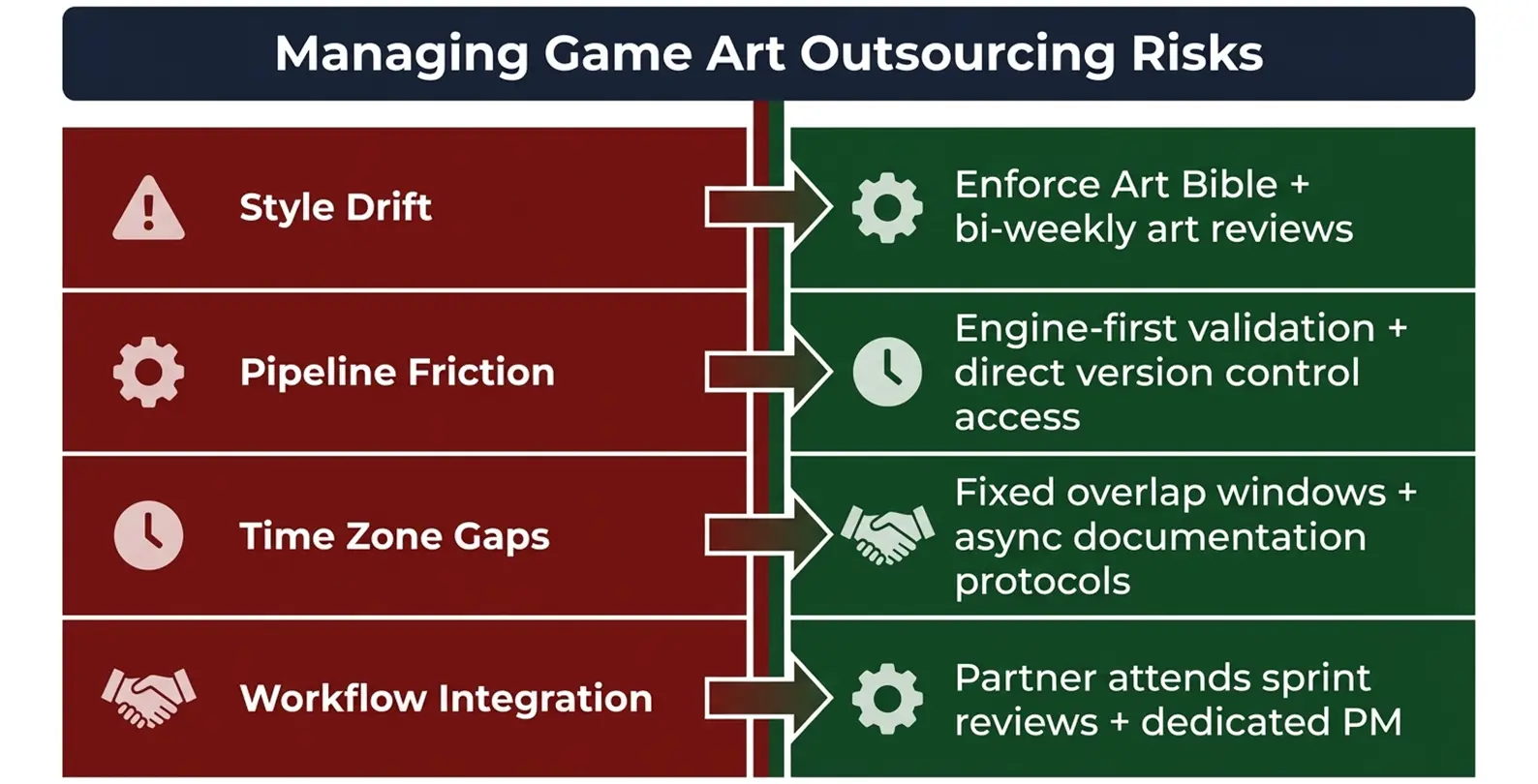
Style Drift Over Long Projects
Visual inconsistency is the most common failure mode in large-scale art outsourcing. When external teams work from incomplete briefs or receive infrequent feedback, asset styles drift from the established visual direction. The mitigation is centralizing art direction, maintaining a strict Art Bible, and conducting bi-weekly art reviews with senior leads.
Pipeline and Integration Friction
Assets produced externally that have not been validated against the game engine generate rework costs that erode the efficiency gains of outsourcing. External teams should work within the studio’s version control environment from day one, with access to the engine project and clear technical specifications before any asset enters production.
Time Zone and Communication Gaps
Australian studios working with partners in Europe, South Asia, or Southeast Asia face time zone differentials of 4 to 10 hours. This is manageable with deliberate scheduling: establishing a fixed daily overlap window, using asynchronous communication tools for non-urgent feedback, and setting clear response time expectations in contracts.
Integration with Internal Development Workflows
External art teams that cannot read or respond to the internal development context create coordination overhead for producers. The best outsourcing partners function as embedded collaborators — participating in sprint reviews and proactively flagging blockers before they compound.
What Getting It Wrong Actually Costs
Treating outsourcing challenges as manageable inconveniences rather than structural risks has measurable business consequences:
| Failure Mode | Operational Impact | Business Consequence |
| Missed art milestones | Downstream engineering and QA cycles are delayed | Publisher trust erodes — repeat contracts at risk |
| Inconsistent visual quality across asset batches | Art director rework consumes 20–30% of the sprint capacity | Rework cost compounds; internal team morale declines |
| Poor pipeline alignment (assets not engine-ready) | Integration overhead per asset adds 30–50% to QA time | Budget overruns on the production phases that follow |
Studios that have experienced even one of these failure modes typically report that the downstream cost exceeded the original art outsourcing contract value, making upfront partner vetting and process infrastructure the highest-ROI investment in any outsourcing engagement.
Where Juego Studios Fits In
Juego Studios operates as a full-cycle game development and co-development partner with a dedicated game art production capability. As a video game development company with over a decade of experience and 200+ delivered projects across mobile, PC, console, AR/VR, and web, Juego Studios serves global publishers and studios as a scalable outsourcing partner — not a one-off asset vendor.
For Australian studios evaluating outsourcing game art for Australian game developers, Juego Studios offers several structural advantages. Art pipelines are built around game engine compatibility — Unity and Unreal Engine — with technical art specialists who produce LOD-optimized, PBR-textured, engine-ready assets from the outset. Teams integrate into client version control environments (Perforce, Git) and project management tools (Jira, ShotGrid) with established onboarding protocols.
The studio supports the full spectrum of art disciplines: 2D/3D asset production, character and environment pipelines, animation, UI/UX design, VFX, and concept art. Clients with AAA-grade requirements — trusted by Sony, Tencent, Warner Bros., and Disney — and studios seeking mid-core or mobile-grade production both access dedicated teams structured to their specific project requirements.
Engagement models are flexible: managed art pods, staff augmentation for specific skill gaps, and fixed-scope project contracts for well-defined deliverables. For Australian studios utilizing the DGTO, structured retainer engagements can be aligned to eligible expenditure categories for maximum cost efficiency. Communication operates across US, UK, and India-based teams, providing practical time zone coverage for Australian clients requiring overlap windows in both AEST morning and afternoon.
The Future of Game Art Production and Outsourcing
The practice of outsourcing game art production is evolving rapidly in 2026. Several converging trends are reshaping how Australian studios and their partners approach external production:
- AI-Assisted Art Pipelines: AI-assisted tools — generative concept art, texture synthesis, automated LOD generation — are being integrated into production workflows. These tools accelerate iteration cycles and reduce time spent on repetitive asset variations. Studios that select partners operating AI-augmented pipelines benefit from faster turnaround without sacrificing quality gatekeeping.
- Engine-Ready Delivery as Baseline: Engine-ready delivery has become a baseline requirement rather than a differentiator. As live-service roadmaps demand higher content velocity, studios cannot absorb the overhead of assets requiring post-production rework. The expectation is that outsourced assets arrive validated, optimized, and committed to the build.
- Maturing Global Collaboration Infrastructure: Real-time co-authoring tools, cloud-based version control, and distributed review platforms have reduced the operational gap between in-house and external teams. Australian studios are increasingly treating outsourcing partners as extended studio arms rather than external contractors — with implications for how contracts are structured, and performance is measured.
- Rising Player Expectations Driving Volume: As benchmark titles on next-gen platforms and mobile raise the visual quality bar, art production requirements for competitive titles will continue to increase. Video games in Australia are now held to global quality standards by their audiences.
- Expanded International Partnership Opportunities: The DGTO and Australia’s growing industry profile are attracting more international co-development interest. Studios that have already built scalable outsourcing relationships will be better positioned to take on larger co-development mandates with global publishers.
- Demand for Specialized Niche Expertise: Rather than generalist outsourcing studios, the trend is toward partners with deep domain expertise — real-time VFX, technical character art, XR-optimized assets. Studios that identify and build relationships with specialists early will carry a production quality advantage as the market raises its benchmark.
Conclusion
Outsourcing game art production for Australian game studios is a strategic production decision that, when executed with the right partner and engagement structure, delivers measurable advantages: faster asset pipelines, cost efficiency aligned to project phases, access to specialist talent, and scalability that permanent hires cannot provide.
The practical requirements for successful outsourcing are consistent across studio size: a formal Art Bible, engine-first technical standards, integrated collaboration tools, IP-protective contract frameworks, and a partner capable of functioning as an embedded production team rather than a remote vendor.
As AI-assisted workflows, engine-ready delivery standards, and global collaboration infrastructure continue to evolve, the studios positioned to compete internationally will be those that treat game art outsourcing as a core production competency rather than a last resort. For Australian developers, the opportunity is significant — and the infrastructure to execute it well already exists.
Frequently Asked Questions
Australian studios commonly outsource concept art, 2D/3D asset creation, character and environment design, animation, VFX, and UI/UX design to external specialist teams.
The 30% DGTO, combined with state incentives, can reduce effective development costs by up to 45%, making managed outsourcing retainers more financially viable for eligible Australian studios.
A fixed-scope project-based contract is recommended for first-time outsourcers. It limits financial exposure, defines deliverables clearly, and provides a low-risk way to evaluate partner quality before committing to a long-term arrangement.
Studios should enforce a strict Art Bible, conduct bi-weekly art direction reviews, and define per-category acceptance criteria before production begins to prevent style drift across large asset volumes.
High-fidelity AAA characters typically cost $3,000 to $15,000+, while stylized or mobile-grade characters range from $800 to $3,500, depending on complexity and the partner studio’s region.
Related Posts
Outsourcing Game Art Production for Australian Game Studios
This blog talks about how outsourcing game art production enables Australian game studios to scale creative pipelines, access specialized global talent, and manage costs effectively — covering types of art outsourced, engagement models, key benefits, and future industry trends.
3D Game Art Outsourcing in 2026: Costs, Studios, and Execution Models Explained
Visual standards in games have escalated sharply. High-poly characters, cinematic environments, real-time lighting pipelines, and engine-optimized assets are now baseline expectations, not premium features. Internal teams, no matter how strong, cannot expand infinitely without affecting cost structure, delivery speed, or creative consistency.
That reality explains why 3D game art outsourcing has shifted from tactical support to strategic production design. The global 3D game art outsourcing market is expected to reach $2.7 billion by 2028, signaling sustained demand from publishers, studios, and IP owners who need scalable art capacity without destabilizing core teams.
When used correctly, outsourcing does not dilute vision. It protects it. It allows internal leadership to retain art direction while external specialists handle production volume, style replication, and pipeline execution. This guide breaks down how 3D game art outsourcing works in 2026, including costs, engagement models, processes, and the studios that execute at scale.
A Guide to 2D Game Art Outsourcing in 2026: Studios, Cost, and Best Practices
Stylized 2D games are everywhere in 2026. From character-driven indie titles to content-heavy mobile LiveOps games, visual identity is often the first growth lever. As production demands rise, 2D game art outsourcing has become a core scaling strategy for studios that need consistent asset output without slowing development.